

Corporate clothing for store and retail employees - how to dress your sales team
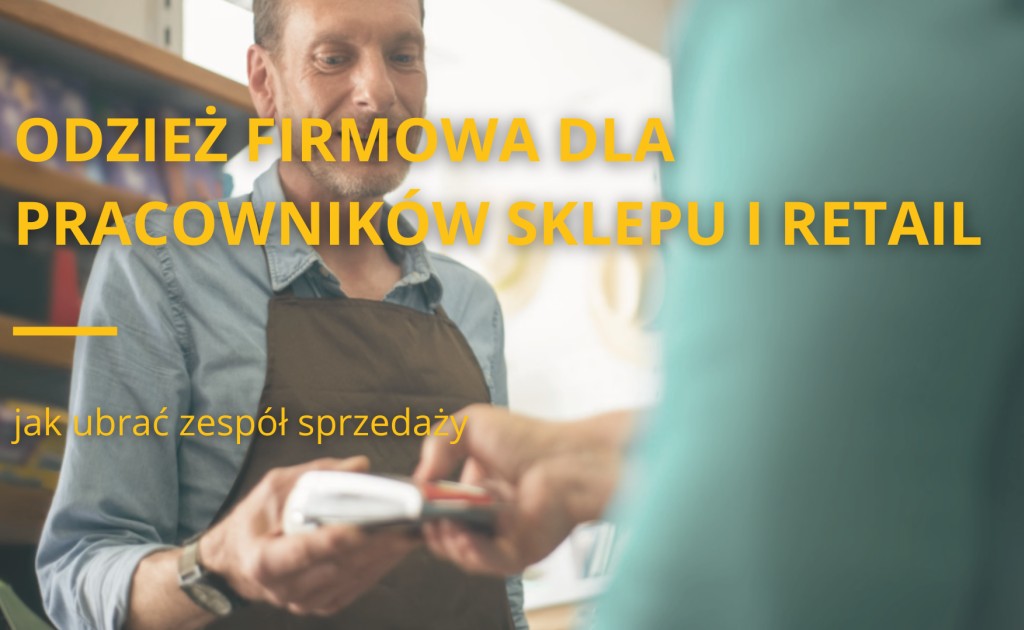
Branded clothing builds a store's image, because a consistent, professional look across the team affects how quickly and how positively a customer judges the reliability of the service - we form first impressions in a fraction of a second, before a single word is even exchanged. In retail, this has an added practical dimension: a customer walking into a store needs to instantly recognize who's staff and who's another customer - branded clothing solves this immediately, without extra signage or name badges. Below, we show what clothing to choose for sales associates and cashiers, what works better for specific types of stores, how to pick colors and branding, and how to order full sets for the whole team without a sizing mess.
Why does branded clothing build a store's image?
Branded clothing builds a store's image mainly through two mechanisms: it enables instant employee identification and it works through the so-called halo effect - customers unconsciously attribute more competence and trustworthiness to people in consistent, tidy clothing than to people in random, mismatched outfits. This is a well-documented phenomenon in first-impression psychology - judgments about competence and trustworthiness form within the first seconds of eye contact, so how the team looks matters before the customer even asks their first question. In practice, this translates into concrete business benefits:
- Faster service - a customer immediately knows who to approach with a question, instead of scanning the room for someone who "looks like staff."
- Brand consistency at the point of sale - a team in matching clothing looks like an organized company, not a random group of people.
- Extra, free logo exposure - in high-foot-traffic stores, staff clothing becomes another constant brand touchpoint.
It's worth keeping in mind that consistent clothing cuts both ways - well-designed clothing raises the perceived quality of service, but with unsatisfactory service, a customer will just as easily associate the negative experience with the brand visible on the shirt.
What clothing should you choose for sales associates and cashiers?
Clothing choices for sales associates and cashiers are worth differentiating based on the nature of the role, since both positions have different customer contact and different physical demands. Sales associates move around the entire sales floor, so their clothing needs to be visible from various distances and comfortable during constant movement - a polo shirt or t-shirt with a clear logo on the chest and back works well here. Cashiers spend most of their time behind the counter, so the customer mostly sees them from the waist up - here, the logo placement on the upper part of the garment (chest, collar) is what matters most, while the overall silhouette is less important. It's also worth factoring in the type of store:
- Clothing stores and boutiques - staff often embody the brand's style themselves, so shirts or polos styled close to the sold collection work better than a purely classic uniform.
- Large-format or chain stores - the priority is visibility from a distance and easy identification, so a contrasting color and a large, legible logo work well.
- Seasonality - in colder months, it's worth adding a branded sweatshirt or vest so staff don't have to wear their own unbranded outerwear on the sales floor.
T-shirts, polos, or sweatshirts - what works in retail?
The choice between a t-shirt, a polo, and a sweatshirt depends on the store's character, the budget, and how formal an image the brand wants to build - none of these options is universally best for all of retail.
| Clothing type | Character | Best use case | Cost |
| T-shirt | Casual, relaxed | Specialty stores, boutiques, lifestyle brands, younger teams | Low |
| Polo | Professional, polished | Chain stores, large-format retail, frontline customer service | Medium |
| Sweatshirt / vest | Practical, seasonal | Colder months, stores with large, cool sales floors, adjacent warehouse space | Medium-higher |
Polo remains the classic choice in retail, since it balances a professional look with comfort during a full day of work on your feet, while t-shirts are gaining popularity in stores with a more casual, lifestyle-oriented positioning, where a stiff, uniform-like look would clash with the brand's character. In grocery stores, bakeries, or counter-service points, a branded apron worn over a t-shirt can also be a good addition - it protects the clothing underneath and further exposes branding at the front.
Colors and branding for store staff clothing
The color of staff clothing is worth choosing so that it's consistent with the brand's visual identity, while still contrasting enough with the logo to stay legible from a few meters away. Shades that are too close between the shirt and the logo make the branding visually "disappear," even though it's technically applied correctly. When planning colors and branding, it's worth considering:
- Contrast between the logo and the background - a dark logo on a light shirt or vice versa, depending on the brand's colors.
- One consistent color scheme across the whole team - different shades of the same color on different employees dilute the effect of a unified team.
- Distinguishing roles by color or accent - e.g., a different polo color for a shift manager than for the rest of the team, making it easier for customers to quickly identify the decision-maker.
- Legibility under store lighting - some colors and printing techniques look different in daylight than under a sales floor's artificial lighting, so it's worth checking this on a sample before ordering the full batch.
How do you order clothing sets for the whole team?
Ordering clothing sets for an entire store team is best started with a precise size breakdown, since this is the most common cause of delays and additional follow-up orders. In practice, the process looks like this:
- Collecting sizes for the whole team - ideally with a small buffer for staff turnover, so you're not placing single-piece orders every time someone new joins.
- Choosing the model and personalization technique - embroidery for clothing worn long-term and washed often, screen printing or DTF for larger, more colorful logos or shorter replacement cycles.
- Online quote - at Feelgood.pl, this takes about 5 minutes, with no phone contact required at this stage.
- Design approval and production - standard turnaround is up to 48 hours from design approval.
For stores with high staff turnover, it's also worth asking about recurring orders or the option to order single additional pieces in the same design - this lets you quickly dress a new hire without waiting for another large order and without risking a color mismatch with the rest of the team.
FAQ
1. What clothing works best for clothing store employees?
Clothing styled consistently with the sold collection works best - a t-shirt or polo with a logo, chosen so the employee represents the brand while still being easily recognizable as staff rather than a customer.
2. Does work clothing need to have the company logo?
It doesn't have to, but a logo significantly helps customers identify staff and strengthens brand visibility at the point of sale - without it, it's harder to tell staff apart from customers, especially in larger stores.
3. How do you handle sizing for clothing for the whole team?
It's worth collecting precise sizes from every employee before placing the order and ordering a small buffer in the most common sizes, so you can quickly dress a new hire without waiting for a separate order.
4. How much does printed clothing for store employees cost?
The price depends on the type of clothing, the personalization technique, and the order size - the larger the team, the lower the unit cost. An exact quote can be obtained online in about 5 minutes.
5. Is it worth differentiating clothing by role, e.g., sales associate vs. cashier?
Yes, if the roles differ in the amount of customer contact - e.g., a different color or accent (a vest, a different collar color) for a shift manager makes it easier for customers to quickly identify the decision-maker.
6. How often should you replace branded clothing for a store team?
It depends on usage intensity and the personalization technique - embroidered clothing, washed more often, lasts longer than printed clothing, but regardless of technique, it's worth replacing it once it starts looking faded or worn, since that affects the store's image.
Search
Newsletter