

How much does custom corporate clothing cost? Pricing and key cost factors
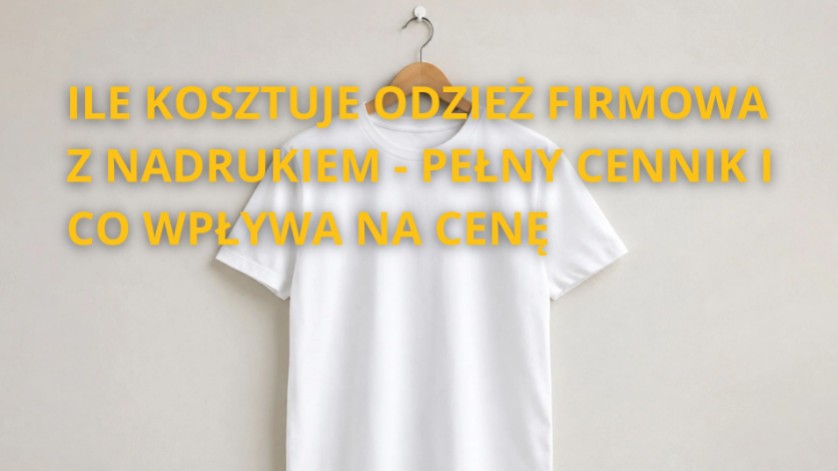
How much does printed corporate clothing cost? There is no single price that applies to every order.
The final cost depends on the type of garment, selected model, order quantity, size of the branding and the printing or embroidery technique.
A batch of basic T-shirts with a simple one-colour logo will be priced differently from hoodies with large back graphics or polo shirts with embroidered chest logos.
The easiest way to plan a budget is to think of the final price as a combination of base garment + branding + production setup + optional additional services.
What affects the price of printed corporate clothing?
The garment itself is one of the biggest cost factors.
A basic T-shirt will generally cost less than a heavy hoodie, jacket or premium product.
Key factors include:
- garment type,
- brand and model,
- fabric and weight,
- order quantity,
- number of branding locations,
- print size,
- number of colours,
- branding technique,
- additional services.
Product quality also matters.
Basic garments may be suitable for one-off promotional campaigns, while clothing intended for everyday employee use may justify a higher-quality fabric and better fit.
Printed T-shirt pricing - how much will you pay?
With printed T-shirts, it is useful to separate the price of the blank garment from the cost of customisation.
Basic promotional T-shirts are usually the most budget-friendly option.
Higher fabric weights, premium materials and more refined fits generally increase the base price.
The branding cost depends on factors such as:
- artwork size,
- number of colours,
- print position,
- order quantity,
- printing method.
A small single-colour chest logo will therefore be priced differently from a large full-colour front print combined with additional branding on the back.
Always compare the total cost of the finished customised garment rather than the price of the blank T-shirt alone.
How does order quantity affect the unit price?
With many printing techniques, larger quantities allow production setup costs to be spread across more garments.
As a result, the price per unit can decrease as the order becomes larger.
This is especially noticeable with methods that require additional production preparation.
A company ordering clothing for 10, 50 or 200 employees may therefore receive different unit prices even when the same garment and artwork are used.
However, a larger order does not automatically guarantee a dramatically lower unit cost.
Additional colours, branding locations, employee names or separate designs for different departments can increase production costs again.
For a useful comparison, always compare identical specifications at different quantities.
Printing technique and price - screen printing, DTF and embroidery
The branding method can significantly affect the final cost.
Screen printing
Screen printing is particularly suitable for larger production runs and relatively simple graphics.
Setup costs have a greater impact on small orders, while larger batches allow these costs to be distributed across more garments.
It is often used for:
- larger T-shirt orders,
- simple logos,
- designs with a limited number of colours,
- event and promotional clothing.
DTF
DTF provides greater flexibility for detailed and multicolour artwork.
It can work particularly well for small and medium-sized orders where graphics include multiple colours, small details or tonal transitions.
The size of the print is one of the important pricing factors.
Computer embroidery
Embroidery is frequently selected for more representative corporate clothing.
It works particularly well on:
- polo shirts,
- hoodies,
- fleeces,
- softshell jackets,
- caps.
A small embroidered logo on the chest or sleeve can provide a more formal appearance, making embroidery popular for sales teams, reception staff and customer-facing employees.
For very large or complex designs, however, printing may be a more economical solution.
How to calculate a corporate clothing budget
Start with the number of employees.
Determine:
- how many people need clothing,
- how many garments each person will receive,
- which products are included,
- which garments require branding,
- how many branding locations each garment needs.
A typical employee set could include:
- 2 T-shirts,
- 1 polo shirt,
- 1 hoodie,
- 1 jacket or softshell.
You can then calculate the total cost of the complete set.
It is also worth including some additional stock for new employees, size changes and future replacements.
The next step is selecting the appropriate quality level.
For one-off events, a basic garment with clear branding may be sufficient.
For an everyday employee uniform, investing more in garment quality can make more sense.
Finally, limit unnecessary artwork variations.
Using one logo in the same position across the entire order is generally simpler to produce than preparing individual designs for every employee.
A good corporate clothing budget should therefore consider not only purchase price but also expected usage time.
A cheaper garment that needs to be replaced quickly may not provide better value than a higher-quality product that is worn regularly for much longer.
FAQ
1. How much does a printed T-shirt for a company cost?
The price depends on the T-shirt model, order quantity, artwork size and branding technique. A basic T-shirt with a simple logo will cost less than a premium model with a large multicolour print. Compare the total price of the finished customised product rather than the cost of the blank garment alone.
2. What affects the price of promotional clothing?
The main factors are garment type, fabric, brand, quantity, branding method, artwork size and number of branding locations. Individual names, numbers, special packaging and additional customisation can also increase the final cost.
3. Does a larger order always reduce the unit price?
Larger quantities often reduce the unit cost because production setup expenses are distributed across more garments. However, additional artwork, colours or individual customisation can reduce some of these savings.
4. How should I compare clothing quotes from different suppliers?
Compare identical specifications: garment model, fabric, weight, quantity, branding size, printing method and number of customised areas. A unit price without information about the garment and customisation can be misleading. Also check whether artwork preparation, visualisation, packaging and other services are included.
Search
Newsletter